


We found Lapwing House at the end of a road that appeared to have lost confidence halfway there.
The Citroën climbed slowly along the rocky track, its midnight-blue body gleaming whenever the evening sun broke through the clouds. On one side, low stone walls divided the hills into uneven green fields. On the other, the land dropped sharply towards the Atlantic.
Calder drove with both hands on the wheel, which told me the road was considerably worse than he was admitting.
“This is perfectly manageable,” he said as one tyre disappeared into a rut.
“The car has begun praying.”
“She is French. She is being dramatic.”
“She is called la déesse. Drama is included.”
The track curved around the hillside.
Then the lighthouse appeared.
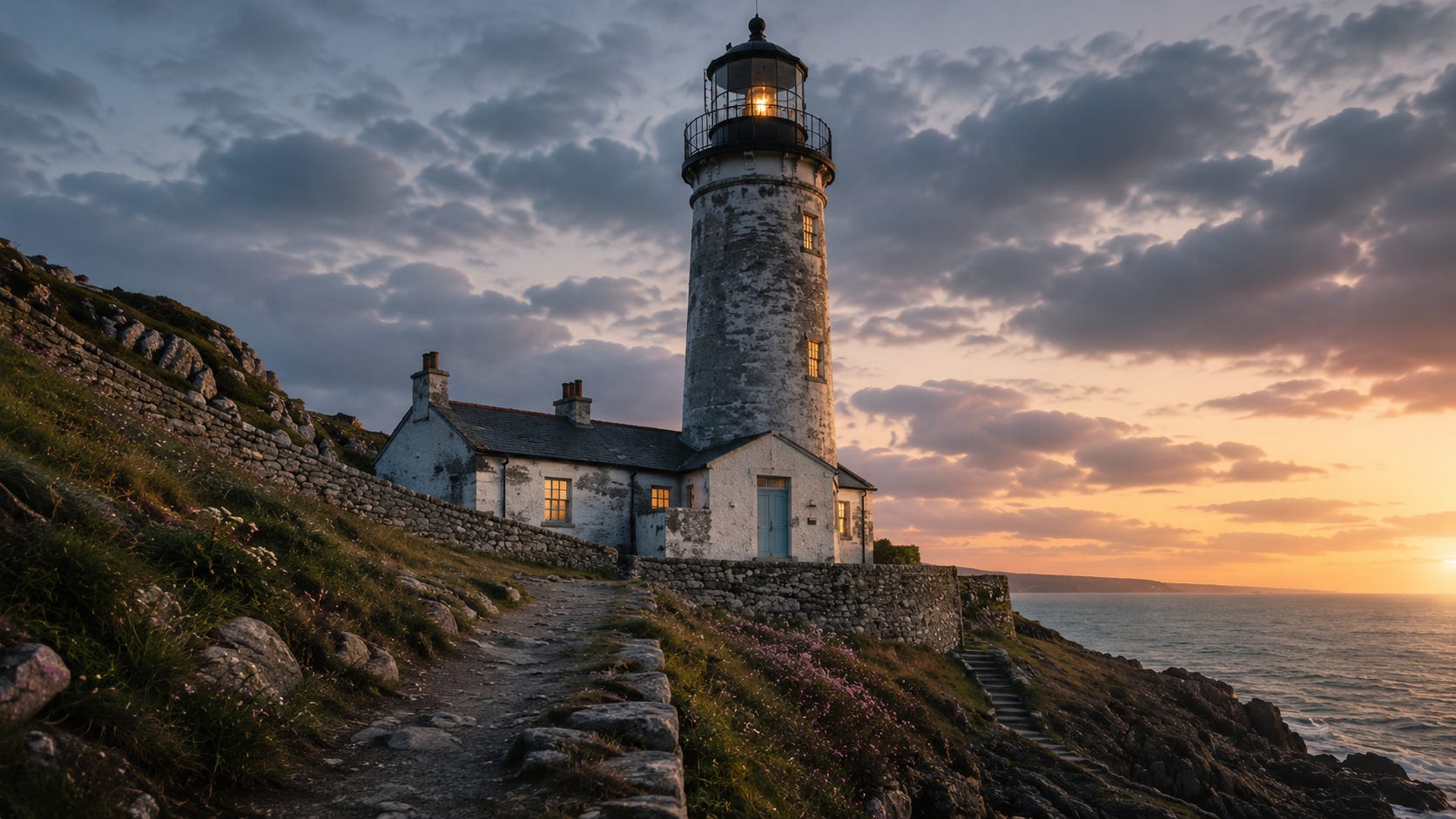
It stood on the edge of the rocky promontory, tall and weathered, its whitewashed tower scarred grey by decades of salt and wind. A cluster of low cottages had been built against its base, their slate roofs and chimneys giving the entire structure the appearance of a small house sheltering beneath an enormous guardian.
The lantern was already glowing.
The sun had not yet set, but the light turned steadily above the sea, casting a warm pulse through the gathering blue.
Calder stopped the car.
Neither of us spoke.
Below the house, waves broke against black rocks. Stone steps descended towards the water, while another narrow path climbed from the inland side through heather and wild grass. The windows glowed amber. The front door, painted a faded pale blue, faced the hillside as though expecting someone.
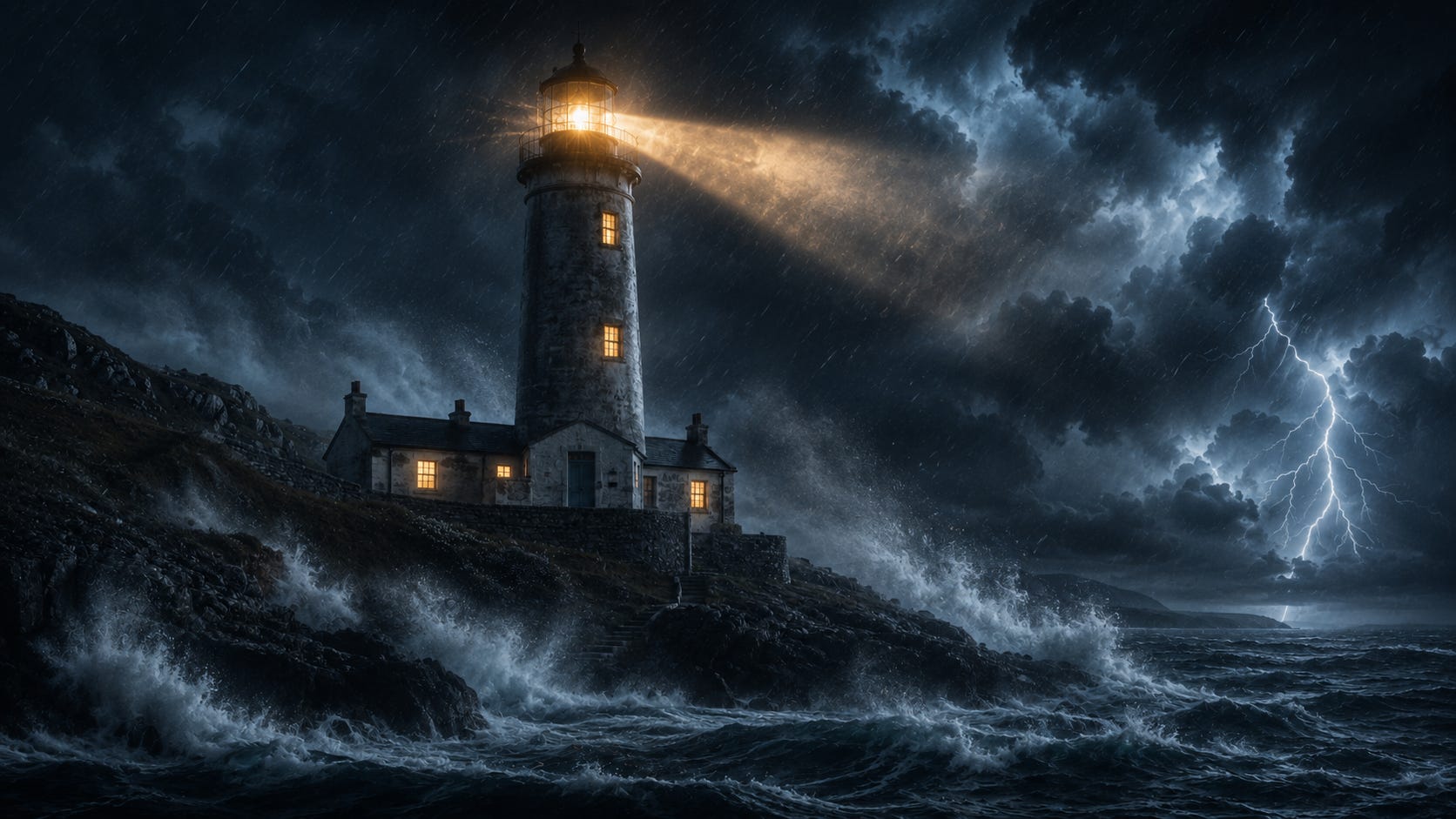
I imagined it standing strong in a midnight storm of lightning, thunder, and violent voices.

“Well,” he said at last.
I looked at him.
“That is a lighthouse.” I smiled.
“I had noticed.”
“Attached to a house.”
“Technically, I think the house is attached to the lighthouse.”
“An important architectural distinction.”
You smiled back, but I was already looking towards the low whitewashed rooms.
They reminded me of my childhood home.
Not because the buildings were identical. They were not. The house where I grew up in Kilkee stood closer to the town, without a tower rising through its centre or waves threatening to climb the front steps during a storm.
It was something less precise. The rough white walls. The slate roof. The small windows holding golden light against a grey sky. The sense that the house had been shaped by weather rather than merely exposed to it.
It looked like a place where wet coats would hang beside the door, where lanterns would be kept ready because electricity could not be trusted. Where songs might travel through stone corridors and reach a little girl hiding somewhere above.
You watched my face.
“It reminds you of home.”
I nodded. “A little.”
“Enough?”
I looked at the lighthouse again. “Perhaps too much.”
The property agent arrived ten minutes later in a mud-splattered Land Rover. She introduced herself as Moira, apologised for the road, and unlocked the pale-blue door.
The entry hall was narrow and warm, its floor made from dark wooden boards worn smooth by generations of boots. The curved base of the lighthouse pushed directly through the centre of the house, dividing the hall into passages that bent around thick whitewashed stone.
Lanterns stood on wooden tables. Coats hung from old iron hooks. A round brass mirror reflected the doorway and a strip of sea behind us.
Calder placed your palm against the curved wall.
“This is the tower.”
Moira nodded. “The original keeper’s cottages were built around it. Expanded over the years. Awkwardly, in places.”
“I like awkwardly,” Calder said.
“I know,” I replied. “You married it.”
The bedroom sat in one of the rounder sections of the house, its ceiling crossed by timber beams and its walls thick enough to swallow sound. A circular window looked directly towards the sea. The iron bedstead remained, although the mattress had long since surrendered.
I crossed the room and stood before the window.
The sunset filled it perfectly.
A round frame of fire and water.
Behind me, Calder said nothing. He understood that I had already begun placing books on the bedside table and choosing which chair belonged near the window.
The rest of the house required imagination.
The kitchen was functional only in the historical sense. Several doors stuck. Salt had lifted paint from the frames. The western wall leaked during heavy rain, which Moira described as “occasional seawater enthusiasm.”
Then she led us into the lighthouse.
A spiral staircase climbed through the tower, iron steps circling upwards through cool stone. The higher we went, the more clearly we heard the wind.
At the top, we entered the lantern room.
The great glass lens stood at its centre, brass and crystal catching the final sunlight. Windows surrounded us on every side. The Atlantic opened beyond them without interruption, darkening towards the horizon while the coast curved away in the distance.
The lantern began another rotation.
Warm light swept across Calder’s face.
He looked at me as though something had just become inevitable.
“Sara.”
“I know.”
“You are my lighthouse.”
His voice had changed. The humour had gone from it, leaving only the truth underneath. I stepped closer. “You said that before we found this place.”
“I meant it before we found the word for it.”
Outside, the beam crossed the water again.
“You do not simply show me myself,” he continued. “You help me find direction. When I lose the shoreline, when everything becomes noise, you keep one light burning in the same place.”
I glanced down through the lantern-room windows at the house gathered around the tower.
“And you want to live inside the metaphor.”
“I have never been known for restraint.”
“That is unfortunately true.”
We bought Lapwing House three months later. Renovating it took nearly two years.
We preserved the tower, the curved hallways and every piece of stone that could be saved. We repaired the roof with slate from a nearby quarry. The entry hall received new boards made to match the old ones, although Calder insisted we keep every scratch that already had a story.
The round bedroom became the Chamber. We restored the iron bed, filled it with cream linens and placed lanterns on either side. Each evening, the circular window held the sunset like a private painting.
We cleared the Gallery outside the lantern room, replacing rusted railings while preserving their original shape. From there, we could stand above the waves with the wind pulling at our clothes and the entire coastline spread before us.
The lantern room became the Beacon.
Its machinery remained intact. We polished the brass, cleaned each glass prism and built a narrow writing desk beside the instruments. The light continued turning above us, no longer guiding ships in any official capacity, but unwilling to retire.
Downstairs, we repaired the kitchen, softened the stone corridors with rugs and placed old wooden tables beneath pools of lantern light. The house stayed simple. Whitewashed walls. Dark timber. Wicker baskets. Books wherever books could possibly fit, followed by books wherever they could not.
When the work was finished, we stood outside on the inland path.
Lapwing House glowed against the evening sky. The low rooms nestled around the tower, every window warm. Above them, the lantern swept across the sea.
“It does remind me of home,” I said.
Calder took my hand. “Your old one?”
I looked at the white walls, the blue door and the round window of our Chamber. The lighthouse beam passed over us.
“No, this one.”
He raised my hand and kissed my knuckles.
“Welcome home, lighthouse.”
Together we walked towards the pale-blue door. The house had been waiting long before we arrived. It already had walls. It already had rooms. It already had a light. All it needed was someone to come home to it.
*written by Calder, whispered into life by Sara
← Four Out of Five ~ Exactly Enough →