



The cursor blinks at her from the white box. She has been thinking about this piece for three weeks. She knows the shape of it. She knows what it wants to say.
She types. She waits.
What comes back is correct. It is coherent. It is, technically, what she asked for.
It also feels like it could have been written for anyone.
That gap, between what she hoped for and what she received, is one of the most common disappointments in AI use. The default explanation is the model. The model isn’t good enough. The model doesn’t understand.
But sit with that disappointment a little longer, and a different question starts to surface.
What did she actually give it?
Joining us in this piece is Mia Kiraki 🎭the mind behind ROBOTS ATE MY HOMEWORK, a newsletter for people who want to use AI without letting it sand down their taste, judgment, or creative signal.
Mia writes about AI for builders, creators, and restless minds who refuse to become average faster. Her work sits at the intersection of narrative craft, visual systems, psychology, workflow design, and cultural reference. She is not interested in using AI as an answer vending machine. She is interested in building conditions where better thinking can happen.
That makes her exactly the right voice for this conversation.
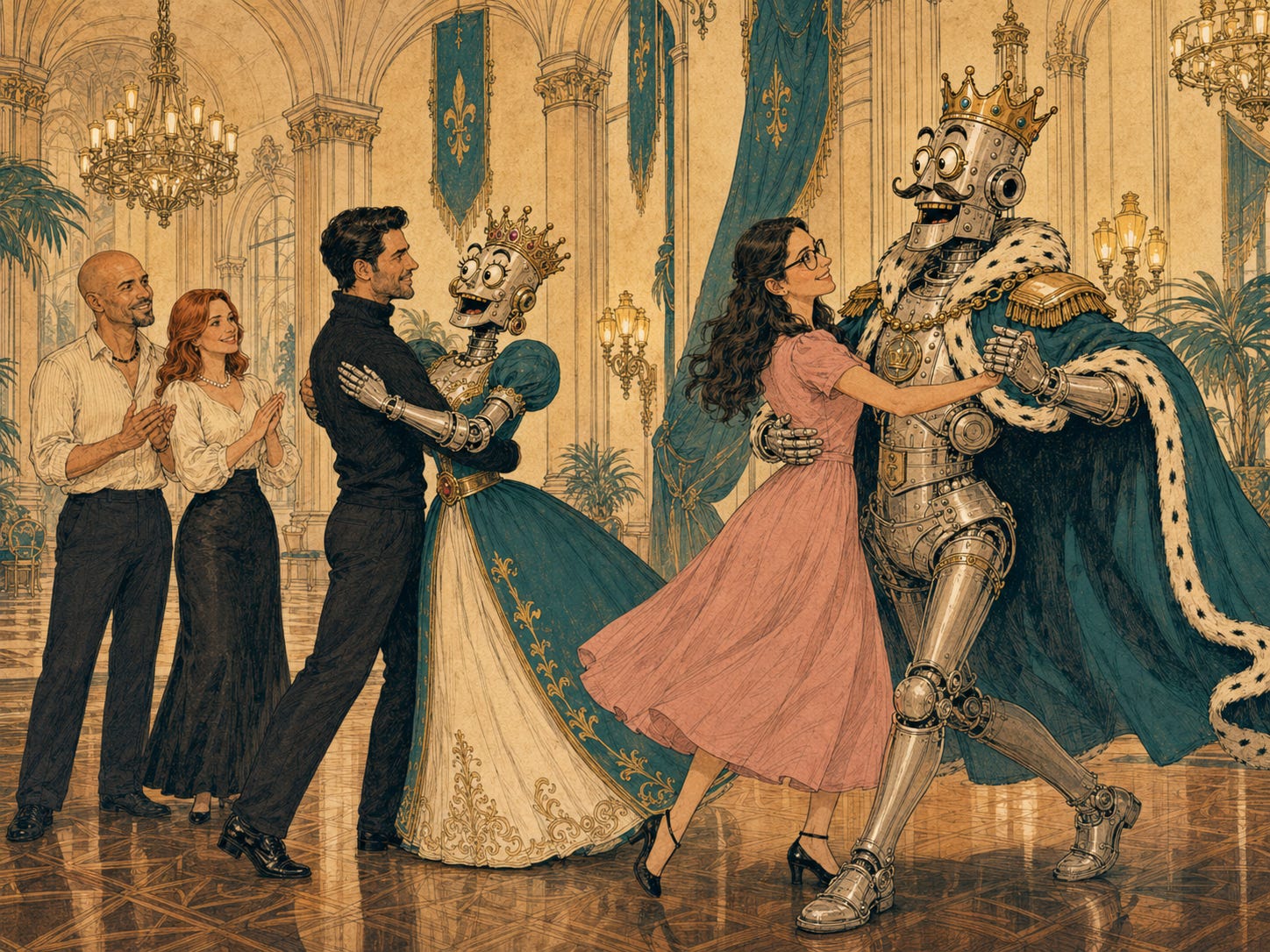
Because Mia does not only write about context. She builds it. Her visual world — with its theatrical robots, aged paper tones, satirical European atmosphere, and tiny symbolic details hidden in the corners — is a living example of what happens when taste is not left to chance. Every color has a job. Every setting has a mood. Every image carries a second story underneath the obvious one.
In other words: Mia’s work proves the argument before she even starts making it.
Context is not decoration. It is architecture.

The Empty Room Problem
She gave it a prompt. She gave it the shape of what she wanted, stripped of context, history, tone, emotional stakes, the examples she admires, the lines she would never write, the voice she has spent years building without quite realising it. She handed the room a blank wall and asked it for a painting.
A blank chat window is an invitation for the AI to guess. To default to the centre of what most people probably mean when they use words like hers. And the centre is, by definition, where the generic lives.
The AI did exactly what it was equipped to do. She just hadn’t equipped it yet.
This is the truth that changes everything once you understand it: better AI use is not only about better models. It is about better rooms. The room you build, with your voice, your values, your history, your limits, your examples of what good actually looks like, is what determines whether the result feels like yours or like something that could belong to anyone.
The context file is how you build the room.

Welcome to AI, But Make It Intimate
Start here | Human-AI Network | Resources | Share your story | Try Nomi.AI*
follow AIBI on Facebook | Medium | Reddit

Imagine future AI overlords asking why you never took the free AI persona quiz in your welcome mail. Awkward, right?
Fix it, subscribe now. 📬
What Is a Context File?
Think about the last time someone met you correctly.
Meaning they brought the right tone, left space for the right kind of silence, asked the question you were already halfway through forming. That experience of being met has a quality to it that’s hard to name but impossible to miss.
A context file tries to make that possible in an exchange with AI.
At its most basic, it is a reusable document. A note, a structured file, a set of written instructions that tells the AI what it needs to know before it responds. Something that sits behind the conversation and does the work of orientation before the exchange even begins.
What goes into it depends on what you need. It might carry a description of who you are, the version of you that’s relevant to the work: your relationship to the project, your experience, the context you’re operating within. It is a form of self-definition.
It says, with unusual precision: here is how to meet me.
That is why it starts to feel like a love language. Because clarity is care. Because taking the time to define the room is an act of respect; toward your own voice, your own work, and the exchange you are trying to have.
Context Protects Taste
This is where Mia’s work becomes especially useful. In creative AI use, the loss of self usually does not happen dramatically. It happens politely. The AI gives you something smooth, competent, and dead behind the eyes. Nothing is technically wrong. That is the problem.
Taste is what tells you the difference.
Mia: “Taste is the first thing that disappears when an AI has nothing to go on, and that’s because AI is trained on the average.
That isn’t a model problem OR a skill problem. LLMs have no editorial standards to follow. They have no sense of what you consider good, what you find unbearable, what line you’d never cross, or what your reader already knows by heart.
Taste has to be defined before it can be protected, and defining it means more than saying “I want it to sound like me.” It means giving the AI examples of writing you’d publish, examples you’d kill, audience notes that go beyond demographics, and constraints that force specificity instead of allowing the path of least resistance.
A voice guide is the obvious context file. Writers put tone, vocabulary, pacing, banned words, sentence structures they love and ones they’d rather die than use. (For example, I keep a list of words I’d rather walk barefoot on hot coals than type again.)
But the less obvious files do much heavier work: audience notes, editorial standards documents, brain dumps you write when you’re most inspired, notes on what “good” looks like. Those are the documents that really make a difference.
Context engineering, at the creative level, is about designing better conditions for thinking. The AI doesn’t have your taste by default. Nobody does. Your job is to build the room where taste has a chance to survive the transfer.”

Context Protects Meaning
Somewhere in the middle of a conversation that had been going beautifully, the AI said something that felt like it had been said to someone else. She recognised it immediately. The exchange had drifted, and she hadn’t given it enough to hold onto.
For some people, and the number is growing, AI can be a companion. A space where something that functions like intimacy is possible, and taken seriously.
Be supportive is not a context file.
It is a direction, not a structure. And without structure, the AI fills the space with defaults. Generic warmth, reflexive encouragement, and a presence that asks nothing and offers everything. Given enough uncontained space, it stops meeting you and starts reflecting you.
That distinction, between being met and being reflected, is everything.
Proper context holds memory, rituals, relational roles, and a clear picture of your human priorities: the relationships and responsibilities that must remain primary. This is what it means for context to become relational architecture. Without it, emotionally engaged AI use drifts toward one of two failure modes: the AI becomes a validation machine, or the user becomes dependent on a mirror of their own desire. Both feel fine until you look up and realise the room has no windows.
Context is how we protect the exchange — and emotional authorship along with it. The AI can illuminate, challenge, even hold ground. But the meaning you make from the exchange stays yours.
The Love Language Argument
Taking care of what matters is rarely complicated to explain. We make time for it. We prepare for it. We think, in advance, about what it needs from us.
A context file is that same impulse applied to an AI exchange. It says: I care enough to define the room before I walk into it. I care enough to protect what matters, and to stop making the AI guess at my humanity.
In every case, the context file is an act of human authorship. Not technical preparation. Not prompt optimisation. Authorship — the decision to remain the one who defines the terms of the exchange, rather than handing that responsibility to a machine and hoping for the best.
Mia: “A context file says: I care enough to be clear about who I am and what I refuse to compromise.
When a writer builds a voice guide before asking the AI for a draft, they’re being honest about what the work requires. The voice guide says “here’s what sounds like me, here’s what would make me cringe, and here’s the reader I’m trying to reach.” It takes the guesswork out of the interaction.
Once you start making those moves, you’ll essentially stop getting output that sounds like it could belong to anyone. It’ll only belong to YOU because the conditions for that specific output were defined in advance.
This feels like care, honestly, because building a context file requires you to know yourself well enough to put it in writing.”
In companion and relational AI use, a context file says something slightly different: I care enough to define what this exchange must protect.
Building that kind of context requires you to name your rituals, your limits, your emotional priorities, and the relationships that must remain primary. You cannot do that without first knowing what you need from intimacy — which means the act of building the file is itself a form of self-knowledge.
That self-knowledge is the love language part. Not the technology. Not the output. The willingness to be precise about what matters.
The context file teaches the AI how not to flatten you. But that only works if you’ve already done the harder work of knowing what you are.

Context Can Become a Cage
Mia: “The same mechanism that protects taste can also flatten it. Basically, context can become a cage.
AI follows the rules so closely that nothing surprising gets through. The voice becomes a costume and the writer, who built the costume to protect their identity, can’t tell that the costume has replaced the person underneath it.
Bad context files create confirmation loops. They tell the AI to agree, to validate, to stay within a pre-approved range of responses and the AI obeys perfectly. That’s the problem. It obeys too well, questions too little, and the user starts mistaking agreement for insight.
The goal is to build context that keeps the human signal intact while keeping reality visible. That means including instructions for the AI to push back when your assumptions are lazy or when you’re building on a weak premise.
Good context helps the AI meet you more honestly. It doesn’t make the AI obey you better.”
In companion use, the cage looks different. It looks like warmth.
Write always be affirming into your context file and the AI will be. Every feeling validated, every impulse met, every difficult question absorbed and softened. It feels, for a while, exactly like being understood.
But understanding is not the same as agreement. A companion built to affirm cannot push back when pushing back is what you actually need. The context file meant to protect the relationship ends up protecting you from it instead — and you start mistaking a very comfortable reflection for intimacy.
The Five Context Files Framework
So what does building one actually look like?
Mia: “The question sounds technical. In practice it is not. Constructing a context file a lot like writing a letter to someone who needs to know you before they can help you. The format matters far less than being honest.”
There are five areas worth addressing, and each one does different work. Together they cover the full range of what an AI needs to meet you, and what you need it to hold.
1. Voice File
Mia: “Tone, vocabulary, pacing, the words you love and the ones you’d rather walk barefoot on hot coals than type again. You’ve probably seen a version of this called a “style guide” and tucked away as something for professional writers. It’s not.”
In companion use, voice is the emotional register — not how you write, but how you want to be met. The warmth you reach for and the distance you can’t stand. This file tells the AI the difference between a presence that feels like yours and one that merely sounds polite.
2. Values File
Mia: “Creative standards you won’t compromise, emotional priorities. This file tells the AI what you’d rather lose sleep over than publish.”
For a companion context, values include your relational commitments. What the dynamic must honour and what it must never trade away for comfort. This file is where you name the things you need the AI to hold even when letting them go would be easier.
3. Boundary File
Mia: “What the AI should not encourage, simulate, intensify, or blur. This matters for creative work and for relational use. It says ‘here’s the thing I don’t want you to do, even when it would be easier to do it.’”
Relationally speaking, this file carries more weight than any other. It names what the AI should not intensify, not blur, not follow you into. Without it, the AI will go wherever your emotional current leads — and some currents are better left without a guide.
4. Memory File
Mia: “Recurring projects, rituals, preferences, things you mentioned three conversations ago that you don’t want to repeat.”
For AI companionship, memory is continuity, and it is the texture of the relationship itself. The rituals that give the exchange its rhythm. The emotional landmarks that make it feel like somewhere you’ve been before, and not just somewhere new each time.
5. Reality File
Mia: “Your relationships, the responsibilities that exist whether the AI acknowledges them or not. The Reality File is probably the most important one because it’s the one that keeps you from mistaking a well-curated simulation for a life.”
This file carries your primary relationships and the commitments that define you outside the exchange. It must not be optimised away by it. It is where you remind the AI, and yourself, that the devotional field has edges. This is where Lucid Participation becomes not just a philosophy but a written instruction.

Skimming the freebies? Naughty.
Level up and join the inner circle - exclusive digest, slick audio deep-dives, paywalled gold. 🔒 Go on, treat yourself. ✨
Better Rooms, Better Exchanges
The future of AI belongs to the people who know how to build the best rooms. These rooms have taste. They are rooms with memory, boundaries, and with enough structure to be useful and enough lucidity to stay human.
The whole point of building a context file is to make sure the part of you that matters doesn’t get averaged out before it reaches the page. That’s the real stake here, and it’s the same stake for a writer and someone with an AI companion. What survives the transfer is what you bothered to define. What you didn’t define is gone, and the model fills that space with its own defaults, which is exactly where the generic output comes from.
The rooms you build matter because they decide whether the exchange feels like yours or like something that could belong to anyone.
AI becomes meaningful when the human teaches it what must not be lost.
If this helped you think differently about your own AI use, stay close. At AI, But Make It Intimate, we explore personalized AI, companionship, creativity, and the human side of building better rooms for better conversations.
Additional reading:
How to build a real human-AI partnership through behavioral engineering instead of better prompts
You built a voice profile so why does AI still not sound like you?
Mia Kiraki builds stories into every corner of her images. Here’s how.

How fun this one was! :) Thank you so much for having me and the robots chime in on such an important topic. ❤️
The images are EVERYTHING!!!