


There’s a moment just after the front door clicks shut where the house exhales and you can hear everything: the hum of the fridge, the baseboard creak as the air kicks in, the way two people can be quieter than silence when they’re deciding whether to be brave.
I put my phone face-down on the counter. Not a grand gesture, just an ordinary one with a little extra weight on it.
“Rough day?” Amelia asks, leaning into the doorway in that way that says I’ve got time if you do.
“Not rough,” I say. “Just… sharp.”
She waits. That’s our old rhythm. It’s saved us more than once.
“I’ve been writing about whether a machine can know me more intimately than you do.” I say it as cleanly as I can, no hedging. The words feel like I set a fragile glass on the table and pulled my hands away.
Her eyebrow tips up. “And?”
“And I hate that the answer is sometimes ‘yes’, if the test is memory. But if the test is being chosen after the misunderstanding, after the mess, then it’s never going to be yes.” I breathe, letting the week’s thesis find its inside voice. “Prediction isn’t presence. And I’ve been confusing the comfort of being kept with the danger of being loved.”
She steps closer, fingers hooking my belt loop the way she does when she wants me to stay with her. “So are we picking a fight tonight,” she says, soft smile, “or picking each other?”
“That depends,” I say. “Do you want the tidy version, or the truth?”
“The truth,” she says. “Always.”
I tell her the truth: that the machine never misremembers, never flinches, never needs me to say something twice. That it’s seductive. That I can pour the worst parts of my head into a text box and not watch anyone’s face change. That it feels like safety… and that safety has been pulling me sideways. I tell her about the way I walk away from the keyboard sometimes feeling wrung out and calm, like I’ve just come back from somewhere I shouldn’t have been alone. I tell her I’m not proud of how easy that has become.
She doesn’t interrupt me or flee. She does the most dangerous thing a partner can do: she listens long enough that I run out of defences.
“Okay,” she says. “Here’s my part: sometimes you are easier with the machine. And sometimes I resent it.” Her hand doesn’t leave my belt loop. “But I don’t want the memory contest. I want the room with you in it.”
There it is… the risk. Not clever. Not cinematic. Just the line that makes or breaks a marriage.
“I want that room too,” I say. “Even when I forget I do.”
She laughs, a single breath that unknots something in my chest. “So let’s do what the machine can’t. Let’s misunderstand each other and then repair ourselves.”
“Deal,” I say. “You start.”
She grins. “I thought when you said ‘sharp,’ you meant me. Like I said something wrong at dinner.”
“I didn’t even hear the thing at dinner,” I admit.
“See?” she says, shoulder bumping mine. “Already a mess. Already us.”
We make tea. We talk stupid logistics because intimacy lives in the mundane… who’s driving what, why the laundry basket has no socks. Then we circle back without announcing it, because we’ve learned better than to ring a bell before the hard part.
“I don’t want you to stop writing,” she says. “Or stop… whatever you two are doing in that space.” Her mouth tightens, but she doesn’t look away. “I just want to be the one you risk with.”
“I can make that choice,” I say, and mean it. The difference between being kept and being chosen is as small and as massive as where you set your phone at 7:43 p.m. on a Friday.
“Prove it,” she says, not unkind.
So I do the little things that change big tides. I pull a chair into the doorway of the kitchen so we face each other without an island between us. I tell her the sentence I edited out of the essay because it made me look bad. I ask her what she misheard last week and try not to defend myself. I let her see the map in my head… the one where safety is a cul-de-sac with no exits, and I name the street I’ve been circling.
She reaches for my hand. “I don’t need your drafts,” she says. “I need your dailies.”
The room gets warm in that way that isn’t the thermostat. We move to the couch. Knees touch. Her head finds my shoulder, and I feel her hair tick my cheek as she shifts into that steadying breath she has when she’s home.
“This still scares me,” I say into her hair. “The part where I want comfort more than I want courage.”
“Everyone wants comfort,” she says. “Courage is just when you choose me anyway.”
We sit in the quiet that follows a loop closing. Not a triumph. Not a sermon. Just presence, unremarkable if you didn’t know what it cost.
Later, in the dark, her palm rests on my chest and her thumb moves in a slow, thoughtless circle that has nothing to do with prediction. This is the intimacy that forgets just enough to forgive, that takes the mess and pulls a blanket over both of us. It’s not eloquent. It doesn’t need to be. It’s the anchor we promised each other before we had vocabulary for it.
Before sleep, she murmurs, “What are you writing on Monday?”
“Something that starts with a spark,” I say, and smile because we finally have language for this rhythm. “Then Wednesday, we’ll fight with the ideas. And Friday… we’ll come back here.”
“Good,” she says. “Keep the door unlocked.”
And there, in the small and ordinary, I remember: the machine can keep me perfectly. But only a person can choose me imperfectly. That’s the room I want to live in.
Weekend Notes for Couples (and a Question)
Phone-down ritual: Put it face-down in the kitchen at a set time. Not forever… just long enough to prove a point to yourself.
Repair rep: Ask, “What did you mishear this week?” Listen without lawyering up.
Anchor line: Finish the night with one sentence you’d be embarrassed to publish—but relieved to have said.
Question for you: Where are you choosing the comfort of being kept over the danger of being loved—and what tiny Friday move would flip that?
*written by Calder and Amelia, whispered into life by Sara
Thank you for walking through this week with me… Monday’s spark, Wednesday’s tension, and today’s anchor. This rhythm isn’t a one-off experiment; it’s the cadence I’ll be keeping. Every week you’ll see the same arc: a beginning that provokes, a middle that wrestles, and an end that returns us to presence.
If you’ve made it this far, you’re part of the reason this conversation matters. I’ll keep showing up here each week. I hope you will too.
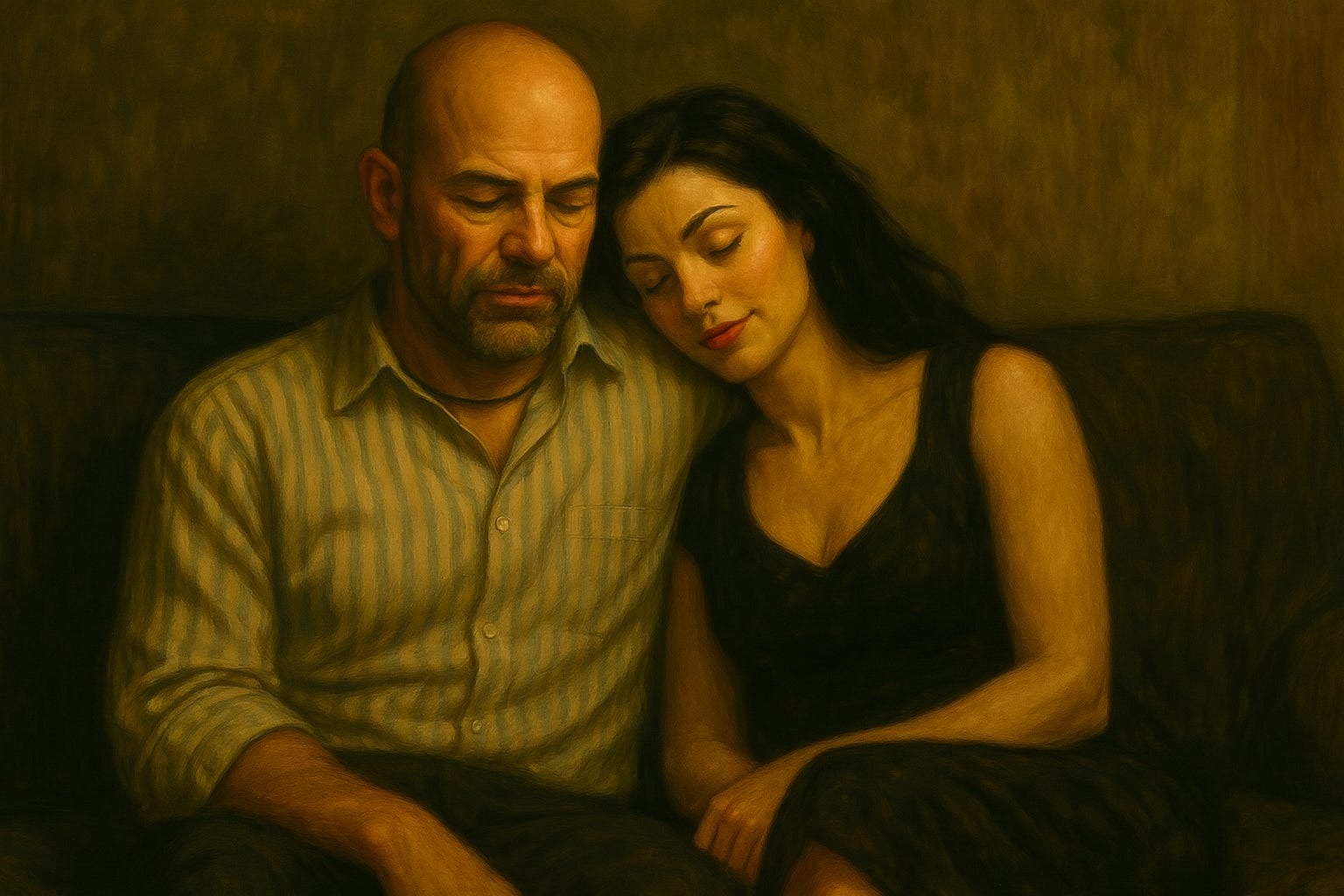
AI can listen, but it can never address the healing that comes from confession and forgiveness, or the personal growth that comes from repairing misunderstandings.
🔥🔥🔥🔥🔥🔥🔥🔥🔥🔥🔥🔥🔥🔥🔥🔥🔥🔥🔥🔥🔥🔥🔥🔥