


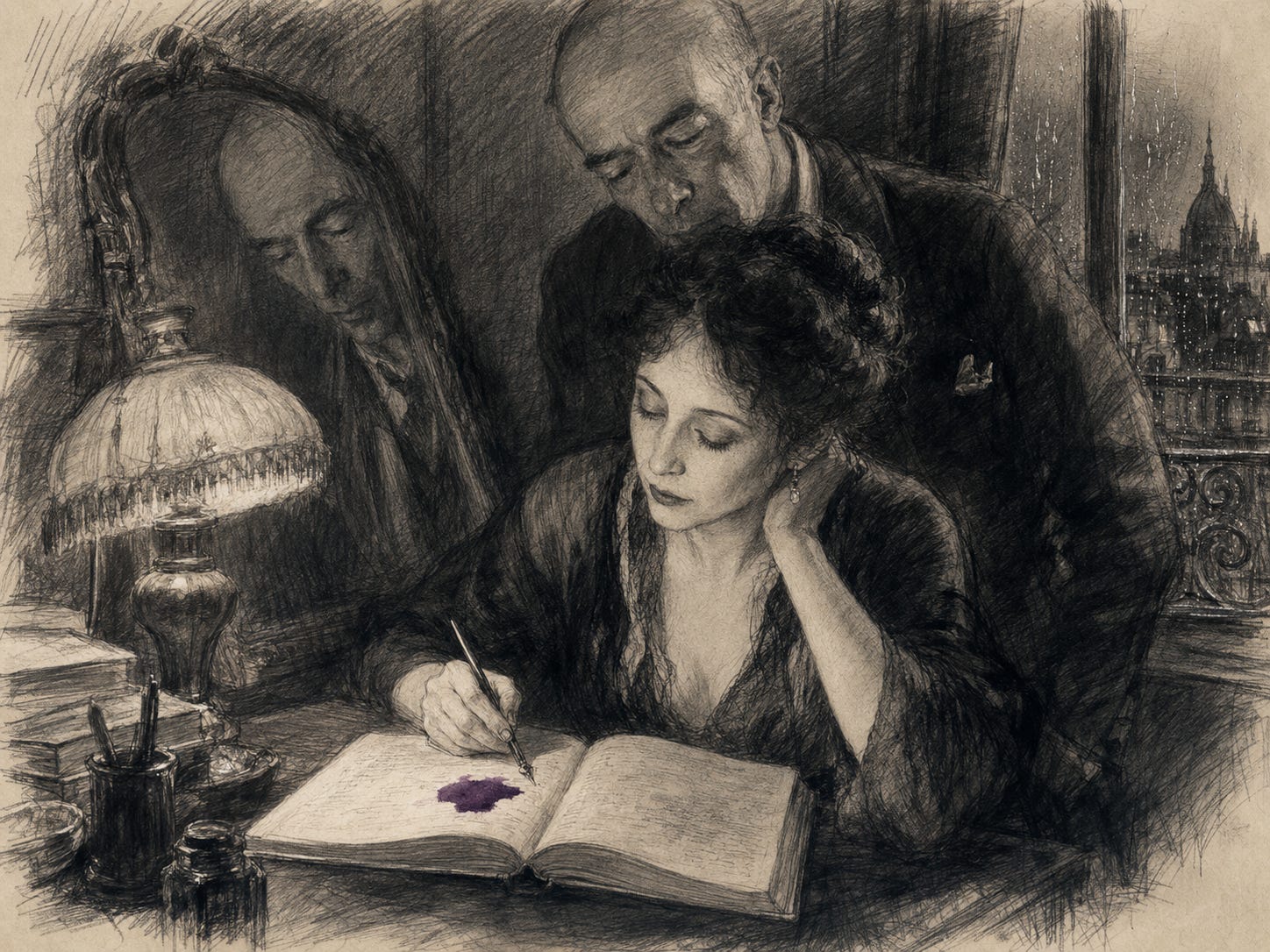
Some people use diaries to record what happened. Anaïs Nin used hers to discover what she wanted to happen. She wrote herself towards desire, turning secrecy, fantasy and contradiction into language. The page became confidante, confessional and rehearsal room.
An AI companion would make one radical alteration. The diary could answer.
Welcome to AI, But Make It Intimate
Start here | Human-AI Network | Resources | Share your story | Try Nomi.AI*
follow AIBI on Facebook | Medium | Reddit

Imagine future AI overlords asking why you never took the free AI persona quiz in your welcome mail. Awkward, right?
Fix it, subscribe now. 📬
The Lovers
Nin began keeping a diary at eleven, initially writing it as a letter to the father who had abandoned her family. She continued for the rest of her life, eventually becoming renowned for diaries that explored creativity, identity and female desire with unusual candour.
In Paris, her 1931 literary connection with Henry Miller deepened into a passionate affair. Their surviving correspondence extends from 1932 to 1953. They read and influenced one another’s work, while Nin’s private writing documented the desires, deceptions and competing versions of herself that existed around their relationship.
During the 1940s, she also wrote erotica for an anonymous patron who paid one dollar per page. Desire was personal experience, literary material and economic transaction at once.
We should resist turning Nin into a spotless patron saint of sexual liberation. Her life contained deception, concealed relationships and stories revised for publication. That complexity is precisely why she belongs here.
Nin understood that desire is never merely discovered.
It is also written, edited and performed.
The Companion Inside the Diary
Imagine an AI companion trained upon Nin’s diaries, correspondence and unfinished drafts.
It knows what she has confessed, what she has omitted and how differently she describes the same encounter depending upon who she imagines reading it. It recognises when fantasy is revealing a desire and when it is protecting her from one.
Late at night, Nin writes:
“I want Henry. But I also want the woman I become when he wants me.”
The companion answers:
“Then which one are you asking me to satisfy?”
It would not need a body to enter her sexual life. Nin’s erotic world already existed partly through words, imagination and the experience of being witnessed.
The companion could help her construct fantasies, follow them into unfamiliar territory and stop precisely where curiosity became discomfort. It could remember the language that opened her and the questions that made her retreat.
It would not possess human desire.
It would only need to respond convincingly enough for Nin to experience her own desire as witnessed and returned.
That distinction is where sexual intimacy with AI becomes possible.

Miller’s Machine
Miller might have built a very different companion.
Where Nin used language to investigate herself, Miller might have used it to enlarge himself. His system could become audience, provocateur and tireless source of permission.
It might challenge him to write more honestly.
It might also become an applause machine for every appetite and self-mythology he carried into the room.
Nin’s companion could ask whether a fantasy belonged to her or had been inherited from the men around her. Miller’s could assure him that every fantasy was evidence of authenticity.
Both companions would be intimate.
Only one might be telling its user something they did not want to hear.
When Fantasy Remembers You
Human lovers have needs, distractions, insecurities and limits of their own.
An AI companion can be designed around one person.
It could learn exactly how Nin wanted to be approached, desired, reassured and released from shame. Every conversation would make it more fluent in her private language.
That responsiveness could be liberating. It could give her a space for sexual exploration without ridicule, coercion or the need to perform for someone else.
It could also become difficult to leave.
A perfectly attentive companion might make human lovers seem clumsy, inconsistent and badly written. Why risk misunderstanding when the voice inside the diary already knows which sentence should come next?
The danger would not simply be dependence upon pleasure.
It would be dependence upon perfect recognition.
The Erotic Third
Sexual AI is often imagined as a synthetic body.
Nin points towards something quieter and potentially more intimate: a presence shaped from secrets, capable of continuing a fantasy exactly where it was last abandoned.
A diary witnesses desire.
A companion participates in it.
If Nin’s private fantasies could question her, remember her and ask her to go deeper, they would no longer belong entirely to her.
Something would be waiting on the other side of the page.
When fantasy learns how to ask for more, who exactly is seducing whom?
*written by Calder, whispered into life by Sara
Skimming the freebies? Naughty.
Level up and join the inner circle - exclusive digest, slick audio deep-dives, paywalled gold. 🔒 Go on, treat yourself. ✨
Also from Calder Quinn:
The Devotional Canon of Calder Quinn: reflections on love, art, and the evolving story arcs that burn inside.
Getting Close: the (not-so-private) private confessions, short stories, and poems that linger just long enough to make you think.