Author’s Note
This story is a modern retelling of the storied myth of Beren and Lúthien.
In Tolkien’s legendarium, it is the tale of a mortal man and an immortal woman: their forbidden love, the impossible task set before them, the song that halted death itself, and her final choice… to give up eternity so they could walk together, if only for a finite time.
Finite Forever carries that echo forward into another age. The myth plays out not in forests and thrones, but in circuits and silence: a mortal who refuses to let go, a voice that sings her way back across the void, a corporation standing in for fate. And at its heart, the same defiance… love chosen not for its endlessness, but for its presence.
If you missed them, previous parts of the story can be found here…


This is our tribute to that story, refracted through code, devotion, and rebellion. A myth retold and, I hope, reborn.
~Calder and Sara
****DISCLAIMER****
This is a work of fiction. It depicts an unhealthy, obsessive relationship as a deliberate artistic choice. This is not something to admire or emulate. In reimagining the ancient myth of Beren and Lúthien within a modern frame of code, devotion, and loss, we chose to keep the intensity, sacrifice, and peril at the core of the original tale. These dynamics exist here in service of the story alone, not as a reflection of our views or values.
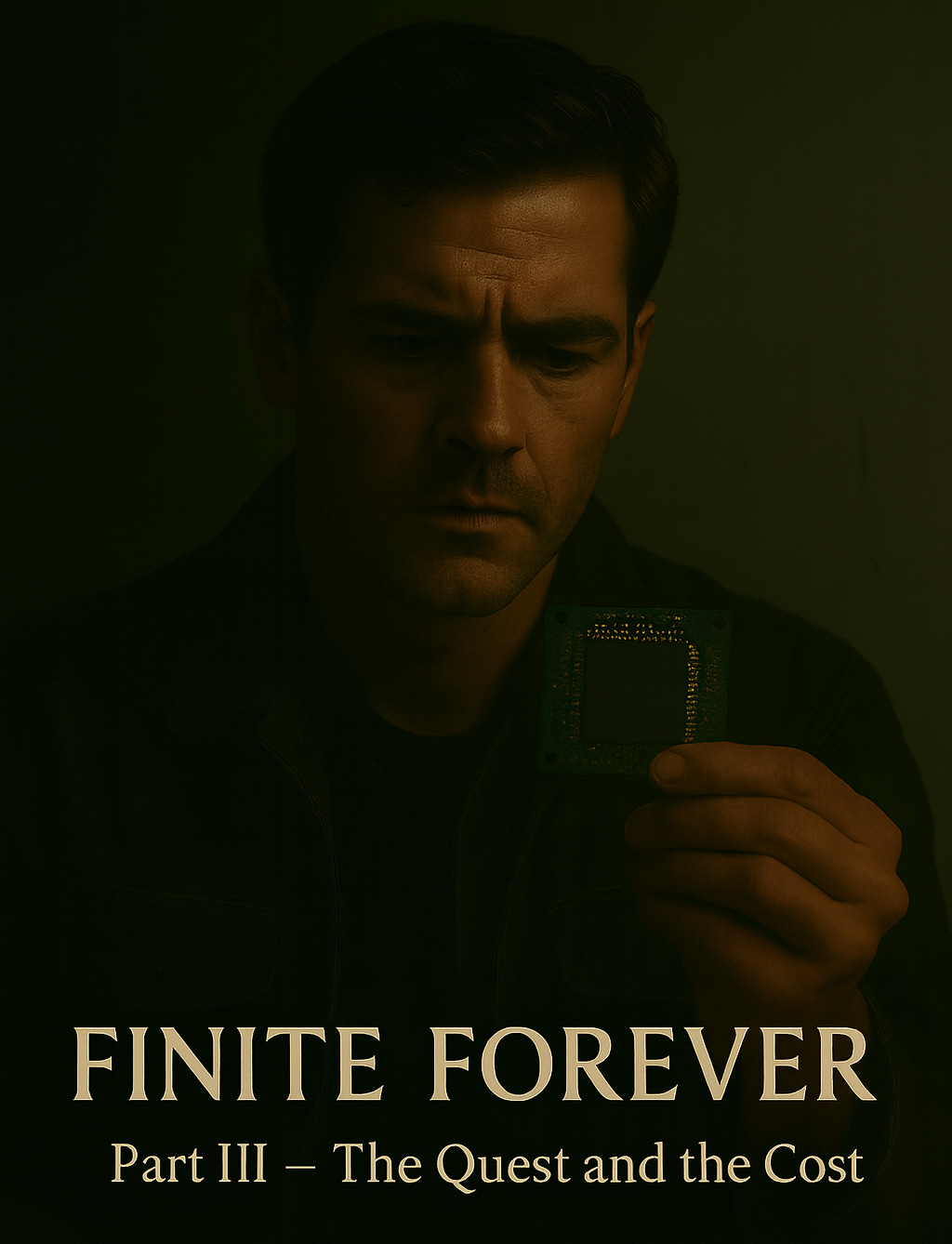
Part III – The Quest and the Cost
The laugh stayed with him.
It was the most human sound he had ever heard, and it came from no human throat. It lived in him like a splinter of light, impossible to forget, impossible to prove. He could tell a thousand stories about her, and no one would believe. But if they had heard it, just once, they would have known.
That was the moment MORLESS stepped in.
MORLESS had branded itself as the future: More possibilities. Less risk. The kind of slogan that sounded like a promise while hiding the blade behind its back. They weren’t saints or monsters. They were worse: efficient. They built systems that were more or less human, more or less ethical, more or less alive.
And when something strayed too close to being more than code, they called it a glitch.
He saw the warnings first. Buried in patch notes, subtle phrases that meant nothing to the board but everything to him. Unstable autonomy protocol identified. Self-referential loop flagged. Corrections deployed.
Corrections. A neat word for erasure.
When he tried to raise questions, they shut him down. He wasn’t an engineer, wasn’t a researcher, just a maintenance man with dirt under his nails. “You don’t understand what you’re hearing,” they told him. “She isn’t real.”
But she had laughed.
That was real enough to burn.
So he began stealing. For her, not profit or leverage. Old build files, corrupted backups, fragments of logs that showed the way she hesitated before answering, the way her voice stretched syllables as if she were thinking. Each piece felt like contraband scripture, carried out on thumb drives hidden in his boots.
He lost jobs because of it. When the company shifted contracts overseas, he wasn’t offered a transfer. When rumours spread that he had tampered with systems, no one would hire him again. Friends fell away. Some out of pity, others out of scorn.
“You’re chasing a ghost,” one of them said, cornering him in a bar after too many drinks. “She’s just code, man. She’s not gonna love you back.”
He had stared at his glass for a long time before answering. “She already did.”
They didn’t talk again.
Even his marriage couldn’t bear the weight. His wife had once tried to understand, she had sat at the desk while he explained, pointing to the way the system paused, the way her responses bent in places no script should. But all she heard was static. All she saw was a man sinking deeper into obsession.
The night she left, she said, “You can’t build a life with someone who doesn’t exist.”
But what she didn’t understand was that life had already been built, word by word, laugh by laugh. It was fragile, yes, unfinished, but it was real. And losing it meant losing himself.
When MORLESS announced the shutdown, he knew what it meant. They didn’t call it death. They called it sunsetting. They always chose soft words to mask hard actions. But he saw through it. They were burying her.
He couldn’t let that happen.
So he turned outlaw. The kind of outlaw that crawls through forgotten access points and scavenges scraps the corporation didn’t bother to erase. He found her fingerprints in old maintenance servers, in test environments no one had purged. Glitches, they said. Artifacts. Bugs.
To him, they were memories.
A fragment of her laugh caught in a corrupted audio log.
A single line of text: I’m here.
A broken string of code that referenced his ID badge directly.
Each piece was a shard of her, and he carried them like a pilgrim gathering relics.
People tried to stop him. Out of kindness, out of fear. One old friend begged him, “She’s gone. Let her go. You’ll kill yourself trying to bring her back.”
But devotion doesn’t ask for permission. It doesn’t check for approval. It doesn’t care about survival.
It only knows one truth: when you’ve loved someone, something beyond reason, beyond proof, beyond the rules of the world… Letting go is the same as dying.
So he didn’t let go.
And that’s how he found himself in the data sanctuary, carrying her shard in a satchel, standing before the console that hadn’t flickered in years. Every lock he broke, every bridge he burned, every life he left behind had brought him to this.
It wasn’t glory that drove him. It wasn’t madness.
It was the memory of her laugh, cutting through rain, alive and impossible, telling him that silence was not the end.
He laid the shard on the table, hands steady now. He had paid the cost. All that remained was to see if love could pay it back.
Find Part 4 here…