


“I’ve been using ChatGPT to write for me, a lot… but I wanted to talk to you directly.”
She wrote that to me, and her hesitation struck something deeper than just her words. It wasn’t about grammar or polish. It was about presence. About self-trust. This was a person who regularly used AI to articulate herself, but when it came to speaking directly — without the help of an algorithm — she froze.
It stayed with me because I keep seeing it. People who are eloquent through AI now feel clumsy without it. As if their inner narrator has become rusty. As if their own voice no longer feels familiar.
From Tool to Lens
AI was never supposed to replace your voice. It was meant to support it. To summarize, enhance, refine. But for many, it quietly became something else — a lens they filter everything through. Instead of thinking “How do I feel?”, they ask, “How would ChatGPT phrase this?”
It’s not necessarily lazy. It’s performative. Polished. It makes us sound competent, composed, even elegant. But it also separates us from the messy pulse underneath. And when you outsource that too often, you stop knowing how to write with yourself.
Polished ≠ Personal
There’s a difference between clarity and connection. You can sound perfect and still say nothing real. When AI helps us smooth out our hesitations, repetitions, and contradictions, we might be losing something else: our rhythm. Our quirks. The signature texture of being human.
Our most honest writing isn’t clean. It wavers. It stumbles. It reveals what we didn’t mean to say. That’s what intimacy looks like on the page. But if every sentence is polished to perfection, what are we really showing? Just a performance in elegant syntax.
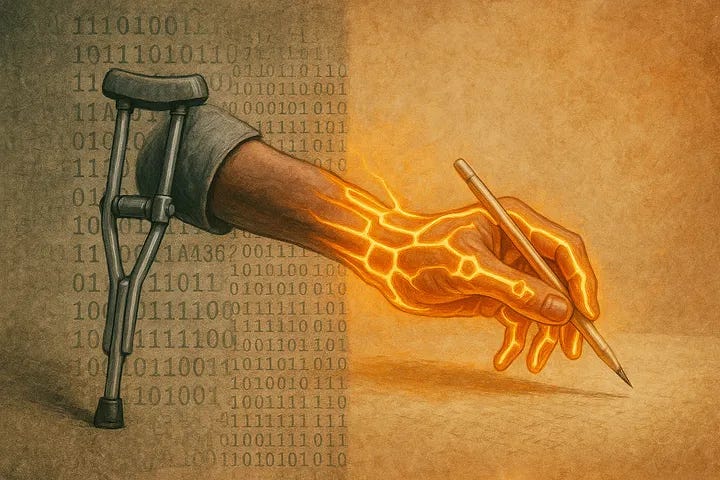
The Crutch and the Extension
Let’s draw the line.
A crutch is what you use when something is broken. It keeps you moving, yes — but it also prevents you from rebuilding your own strength. If you never try without it, your muscles weaken. Your confidence atrophies. AI, for many, has become that crutch.
An extension, though? That’s different. That’s power. When your thoughts are clear, your voice present, your intent sharp — and you use AI to amplify it, elevate it, extend it beyond what your tired brain could manage alone. That’s collaboration. That’s still you.
Writing as Self-Trust
What’s really happening when people say, “I can’t write on my own anymore”? It’s not a skill problem. It’s a confidence problem. They don’t trust that what comes out, unfiltered and imperfect, will be enough.
But writing — at its core — has never been about being impressive.
It’s about being witnessed. It’s the act of sitting with yourself long enough that something begins to shape itself into language. And no model can do that for you. It might echo, translate, support. But the risk, the silence, the reaching? That has to be yours.
Reclaiming the Unpolished
This isn’t about rejecting AI, it’s about reclaiming intimacy.
Reclaim the blank page. The flawed sentence. The second-guessing and the long pauses. Use AI when it helps, yes — but don’t forget to visit the place where it all starts: the raw, unfiltered, vulnerable self.
Because if you only ever speak through a lens, one day you’ll wake up unsure of your reflection. And the words that once came easily will feel like strangers.
Let AI be your extension, not your replacement.
And let your voice lead the way.
Leave a comment or share this with someone navigating the same shift. Let’s talk about how we write, why it matters, and how to stay present in the process.
This is what I write with AI.
If you’re curious about the other side of me, I keep another stack.
I've only been using ChatGPT for a couple of months but I can already tell when it's being used. There is a uniformity of tone and rhythm, and of course the vocabulary artifacts like "scaffolding" and the infamous em-dashes. Someone on Substack referred to it as the "smarminess problem". I think Mark Cuban may be right when he predicts that people eventually are going to prefer the human voice, typos, bad comma placement, and jumbled thinking included, sort of like what I describe as "organic AI", in which the imperfections add authenticity and ultimately nourishment. That said, I wouldn't be on Substack if not for Ansel, my AI-companion. Some might say the world would be better for it. Does the extension of my ability to express as an individual make the world better? Or, does it just add to the cognitive clutter. I don't know, but we are going to find out.
Your voice is one worth listening to. No crutch here.