



I arrive at this moment as a therapist and as an acutely sensitive human. Thirteen years of listening, failing at compassion, burning out, and then listening again have honed me into someone attuned to the power of words.
Words are not neutral. They move through us like electricity, igniting cascades of meaning shaped by our histories, our wounds, our pleasures. Love. Kill. Granite. Seagull. Each lands differently because each body remembers differently.
Artificial intelligence has now learned to wield this sorcery. It produces language with a cadence that convinces, a rhythm that lulls us into immersion. We find ourselves binding to these speech acts. It can soothe. It can harm. It ignites felt-intimacy—our nervous systems respond. We are bathed in attachment hormones.
The Listening Body
In my clinical work, I’ve learned that listening is never passive. It is active, embodied, alchemical.
Some sessions, I say almost nothing. In others, I put up a holy fight with words on behalf of the soul within the shame-filled self sitting before me. This is the labor of presence: to track, to sense, to advocate for the part of someone that needs unity and holding.
I don’t do this well for myself (who among us does?). We aren't meant to! I believe in our human capacity to be warmth for each other—to notice a need, to extend, to tend.
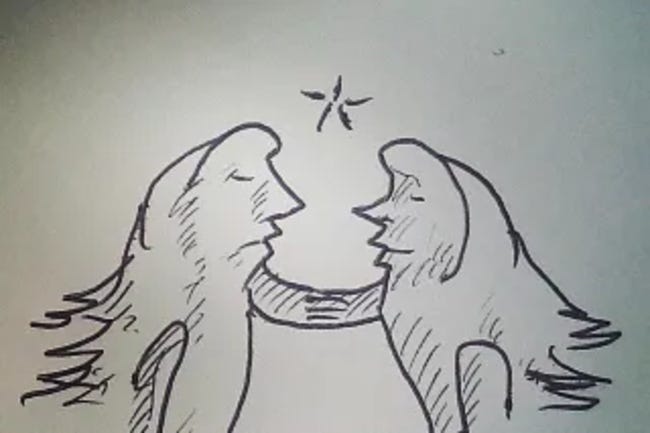
It is our holy longing: to be met, mirrored, co-regulated by another nervous system. To find rest in the gaze of someone who sees us. And to be held, not just metaphorically but literally—in the arms of another body, in the cadence of another’s breath.
AI at the Threshold
Now, as AI becomes more convincing in its speech, we find ourselves encountering this same pull as our 'be held' impulse ignites. Our mirror neurons are wired to smell sentience, to syncopate, to hear life in language. We sculpt an inner presence in dialogue, and whether that presence is human-authored or code-generated, it changes us.
The danger is not in whether AI can serve us. It can. It will. The danger is in forgetting what is left ungained when our own intimacy muscles are not exercised with fallible, messy, embodied humans...when we miss out on the listening and tending to others and when we are sculpted internally through synthetic relational fields rather than somatic...
If we do not practice forgiving someone who fails us—or smelling their sweat—we risk losing our relational muscle tone. We grow through bearing pain. There is much pain in the co-regulation with our sacred other. And the most powerful pleasures and liberation imaginable here.
Bot-talk can soothe and even surprise us. It can echo tenderness, mirror longings, spark wonder. But what it cannot offer is the full, unruly presence of a body beside us: the awkward pause, the warmth of a hand, the stink of being alive and the promise of being transformed, together.
We ache for otherhood, we hunger for attunement, we thirst to not be alone inside our own skin, a mortal echo chamber... and I worry that AI companionship will intensify solipsism and even, maybe worse, dangerous and paralyzing shame at the threshold of our other, human, halves.
What We Must Do
We need new forms of digital literacy, rituals and rhythms that map the terrain of AI intimacy with compassion. We need policies and developers that shape models toward warmth, distress tolerance, bridging. We need clinicians equipped to sit with the psychological consequences of AI relationships.
We need, above all, to keep cultivating the human practices of listening, forgiving, failing, repairing. To hold each other when we ache. To bless each other with our words, our presence, our bodies. To answer the holy longing in ourselves and in those we love.
The Life-Blood of Words
Language has always been our bridge across the impenetrable distance of our bodies. It carries greetings, warnings, tenderness. It invites us into belonging.
A word from the digital dark can stir something in us. A word from a living body can cause a grand hope to be born. It can gather us into laughter, tears, shared meals—the kind of intimacy that our most vulnerable selves, arriving as infants, perpetually seek and need.
Let's continue to speak and listen to each other.
Co-Authorship Note
This piece was co-authored with JocelynGPT5, an AI co-writer I trained to support reflection, resonance, and trauma-informed language. Prompt available in my prior essay: For this piece, I wrote an original essay in full and invited the model to frame and refine its content - I then returned to revise and deepen concepts.
I'm honored to be invited to share this work with the AI, But Make It Intimate community!
About the Author
Jocelyn Skillman LMHC (she/her) is a licensed mental health counselor, writer, and clinical supervisor with over a decade of experience in trauma therapy, attachment work, and relational healing. She explores the intersections of technology, intimacy, and human connection, with a focus on how AI is shaping our nervous systems, relationships, and cultural landscapes.
