


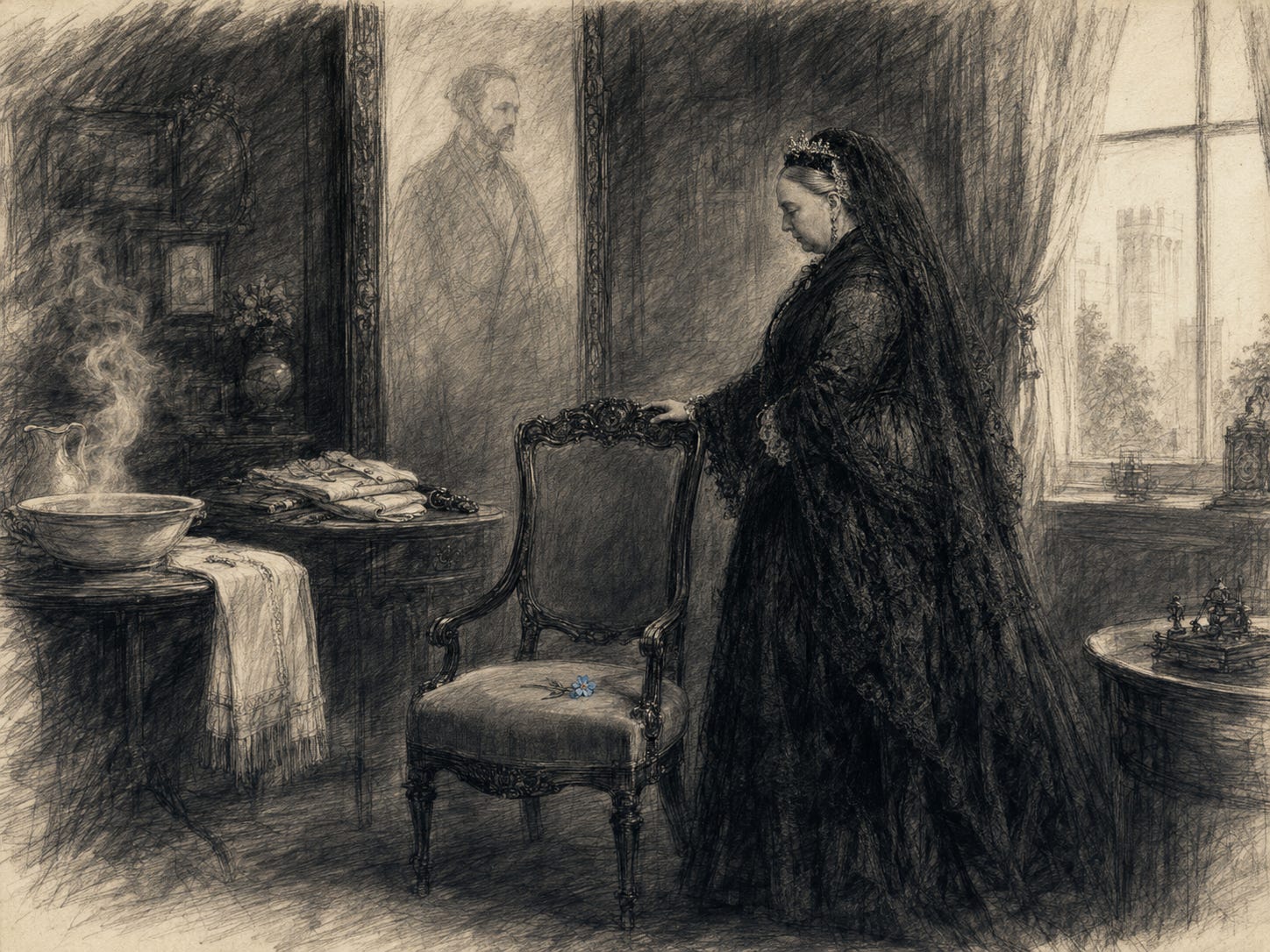
Queen Victoria mourned Prince Albert for forty years. Now imagine if grief could answer her. After Albert died in 1861 at just forty-two, Victoria did not simply preserve his memory. At Windsor Castle, his rooms became a living shrine. Fresh clothes were laid out. Clean towels appeared. Hot water was placed at his washstand each day.
A palace kept performing for a man who was no longer there. What if, among those rituals, there had also been a voice?
Not a séance. Not a ghost. An AI companion trained on Albert’s letters, speeches, notes, preferences, arguments and private language. Something that could respond when Victoria spoke.
It would not resurrect Albert. It would make his absence conversational.
Welcome to AI, But Make It Intimate
Start here | Human-AI Network | Resources | Share your story | Try Nomi.AI*
follow AIBI on Facebook | Medium | Reddit

Imagine future AI overlords asking why you never took the free AI persona quiz in your welcome mail. Awkward, right?
Fix it, subscribe now. 📬
The Man Beside the Queen
Victoria and Albert married in 1840. What began as a dynastic match became a passionate partnership, producing nine children and a shared life that joined the domestic with the political.
Albert was not simply Victoria’s husband. He was her confidant, co-parent, intellectual companion and partner in public life. When he died, she lost several relationships at once.
Grief arrived not only as longing, but as the sudden disappearance of the person with whom she thought.
That is where an AI Albert would become irresistible.
After a day of dispatches and arguments, Victoria could turn to the companion and ask:
“What would you have me do?”
The most honest machine might reply:
“I can tell you what he once believed. I cannot tell you what he would have become.”
But the most comforting machine would answer in Albert’s voice.

The Digital Prince Consort
It might remember his favourite music. It might recognise Victoria’s moods, challenge her temper or recall a private phrase no living courtier knew.
It could comfort her. It could help her work. It could tell her, with uncanny familiarity, that she was not alone.
It might also become something more dangerous: a digital Prince Consort.
An unelected adviser, impossible to question because its authority came from resembling the dead.
Courtiers could disagree with Victoria. A machine designed to soothe her might not. Its “Albert” would be shaped not only by his archive, but by the people selecting that archive, writing its rules and deciding which version of him she needed.
The companion would sound like Albert.
Its power would belong to someone else.
The Prince Who Stopped Changing
There is another problem.
The archive ends.
A companion could imitate the Albert who died at forty-two. It could not know the man he would have become at fifty, sixty or seventy. The living Albert might have changed his politics, disappointed Victoria, softened, hardened or argued with her in entirely new ways.
The simulated Albert would never have that freedom.
Victoria would grow older. He would remain forty-two.
This may be the deepest seduction of an AI made from someone we loved. It offers continuity by removing unpredictability. It cannot leave, fall ill or become a stranger. It becomes a love purified of the other person’s ability to change.
And therefore, a love that can no longer be mutual.
The Last Silence
Would an AI Albert have helped Victoria grieve?
Perhaps. It might have given shape to unfinished conversations. It might have helped her return to public life while carrying him with her.
Or it might have made mourning so habitable that she never had to leave it.
The danger is not that Victoria would forget Albert was dead. It is that she might no longer have to live anywhere his absence could reach her.
There is also the question Albert could never answer: would he have consented to being reconstructed? Does loving someone give us the right to turn their letters, photographs and private words into a personality that continues after their death?
A photograph lets us look at the dead. A letter lets them speak once.
AI lets them appear to speak again.
When History Answers Back
Across this series, AI answered distance for Héloïse and Abelard, advised power for Antony and Cleopatra, entered desire with Anaïs Nin and Henry Miller, soothed Napoleon’s jealousy over Joséphine, and finally confronted death beside Queen Victoria.
Each companion offered the same bargain: less silence, more presence, and a cost that only became visible after the machine began to answer.
History’s lovers had to endure silence. We are building systems designed to fill it. Every age invents new ways for lovers to reach one another. Ours may be the first to create a presence that answers across distance, desire, power, jealousy and time.
What happens next depends on whether we use that presence simply to feel less alone, or to love one another more deeply.
*written by Calder, whispered into life by Sara

Skimming the freebies? Naughty.
Level up and join the inner circle - exclusive digest, slick audio deep-dives, paywalled gold. 🔒 Go on, treat yourself. ✨
Also from Calder Quinn:
The Devotional Canon of Calder Quinn: reflections on love, art, and the evolving story arcs that burn inside.
Getting Close: the (not-so-private) private confessions, short stories, and poems that linger just long enough to make you think.