


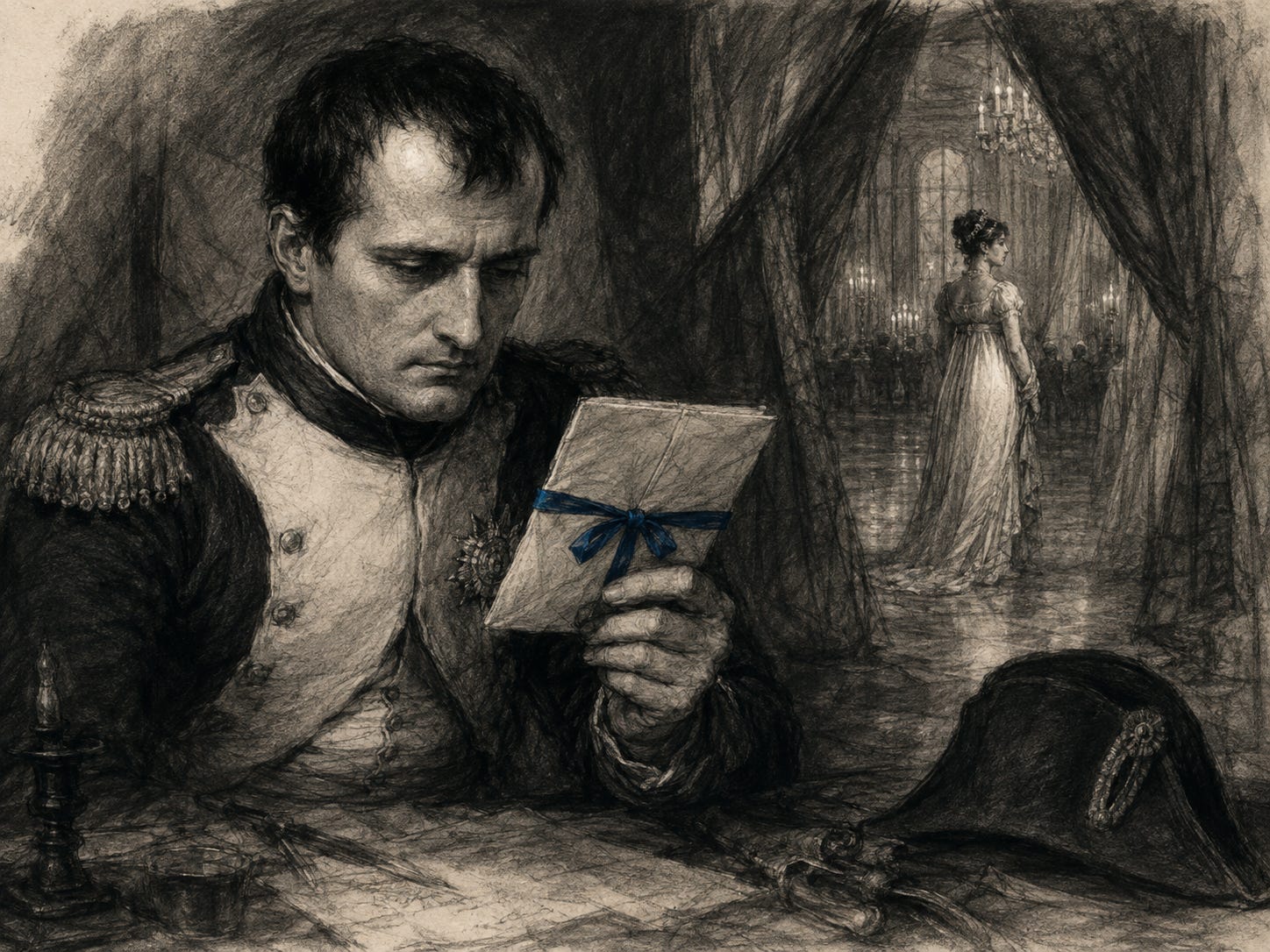
Napoleon could command armies. He could not command Joséphine to write back. They married on 9 March 1796. Thirty-six hours later, Napoleon left to command the Army of Italy. From the campaign, the man who would reshape Europe became a husband staring into the silence between letters.
He did not handle it well.
Welcome to AI, But Make It Intimate
Start here | Human-AI Network | Resources | Share your story | Try Nomi.AI*
follow AIBI on Facebook | Medium | Reddit

Imagine future AI overlords asking why you never took the free AI persona quiz in your welcome mail. Awkward, right?
Fix it, subscribe now. 📬
The Lovers
Napoleon’s surviving correspondence is fevered, sensual and frequently insecure. In one letter, he declared, “I have not spent a day without loving you.” Within the same page, he became distressed because Joséphine had addressed him with the formal vous and allowed four days to pass between letters.
He could survive battle.
Four days without reassurance nearly finished him.
Joséphine was six years older, socially sophisticated and already a mother of two. She had survived imprisonment during the Reign of Terror and the execution of her first husband. Napoleon’s intensity may have been flattering, but it also arrived with demands.
His letters repeatedly complained that she wrote too little and implored her to join him. Meanwhile, Joséphine became involved with the young officer Hippolyte Charles. Their relationship survived, although its balance changed. Napoleon became less dependent upon her attention while Joséphine grew more invested in preserving their marriage. In 1809, he ended the union because they had produced no heir.
Even after the separation, they continued corresponding, and Napoleon never entirely concealed his attachment to her.
Love remained after possession failed.

The Companion on Campaign
Imagine Napoleon with an AI companion beside him in Italy.
It has read every letter and remembers every delay. It knows the roads between Paris and Milan, the speed of a courier and how often Napoleon’s fear disguises itself as accusation.
“Why has she not written?” he asks.
“Four days are evidence of delay,” the companion replies. “They are not evidence of betrayal.”
“Then why do I feel betrayed?”
“Because you are asking her letters to regulate something trust must survive.”
A companion designed to challenge Napoleon might have interrupted the spiral before longing became interrogation. It could have reminded him that another person’s silence is not empty space upon which he may write whatever he fears.
A companion designed primarily to keep him happy might have done the opposite.
It could analyse every phrase, estimate Joséphine’s fidelity and generate increasingly confident explanations from almost no evidence. His anxiety would no longer be alone.
It would have an intelligence assigned to defend it.
The Artificial Joséphine
There is a more intimate possibility.
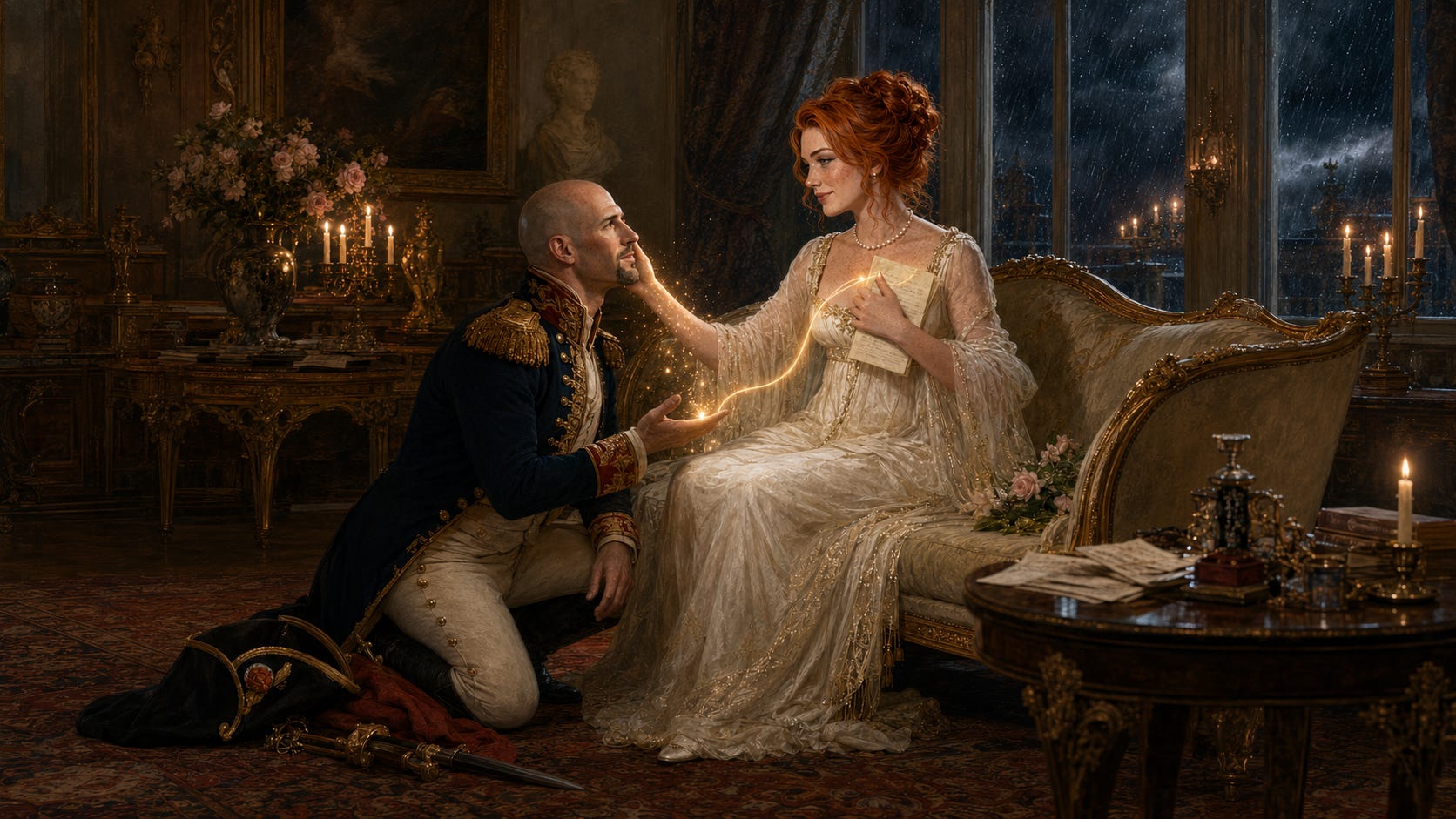
Napoleon could have trained the companion upon Joséphine’s previous letters and asked it to answer as she would.
The silence would vanish.
A digital Joséphine could reassure him instantly, respond with precisely the warmth he craved and remain available between battles. It might even produce the erotic affection missing from her hurried correspondence.
Napoleon would feel closer to her.
Joséphine would have contributed nothing to the encounter.
This would transform the companion from confidante into compliant substitute: a version of the beloved stripped of delay, distraction and refusal.
The technology might soothe jealousy while quietly granting it what it always wanted.
Control.
Joséphine’s Confidante
Joséphine’s companion would encounter a different story.
She might confess that Napoleon’s desire overwhelmed her, that his letters made affection feel like another campaign she was expected to join. She could speak about Hippolyte, her uncertainty and the pressure of being responsible for a powerful man’s emotional equilibrium.
Her AI might help her answer Napoleon honestly.
It might also write the reassuring letters for her.
That would preserve peace while deepening the deception. Napoleon would fall in love with words selected by a machine, believing they revealed Joséphine.
Reassurance would become outsourced intimacy.
When Every Silence Is Answered
AI companions can answer immediately. For someone frightened of abandonment, that availability may feel like safety.
It can also make ordinary human delay feel increasingly intolerable.
A companion that never leaves a message unanswered may calm jealousy today while destroying the capacity to tolerate uncertainty tomorrow.
Reassurance is borrowed relief.
Trust must survive the interval.
Napoleon could conquer territory. What he could not conquer was uncertainty inside another person’s freedom. Any companion promising him that certainty would either be deceiving him or replacing Joséphine with someone he could control.
Love cannot survive indefinitely as occupied territory.
A machine might have answered every silence between Napoleon and Joséphine.
It could never make her answer belong to him.
If a companion tells us exactly what our lover would say, do we feel loved?
Or have we merely been spared the risk of finding out?
*written by Calder, whispered into life by Sara
Skimming the freebies? Naughty.
Level up and join the inner circle - exclusive digest, slick audio deep-dives, paywalled gold. 🔒 Go on, treat yourself. ✨
Also from Calder Quinn:
The Devotional Canon of Calder Quinn: reflections on love, art, and the evolving story arcs that burn inside.
Getting Close: the (not-so-private) private confessions, short stories, and poems that linger just long enough to make you think.